



As urban areas rapidly evolve into smart cities, the demand for reliable, high-performance digital infrastructure has never been greater. Smart cities rely on interconnected systems to manage transportation, energy, public safety, healthcare, and environmental monitoring. At the center of these systems are industrial displays, which serve as essential human–machine interfaces (HMIs) and real-time visualization tools. Their durability, accuracy, and long-term reliability make them indispensable for smart city ecosystems.
Industrial displays are specifically designed for harsh and mission-critical environments. Unlike consumer-grade screens, they are built to operate continuously under extreme temperatures, humidity, vibration, and direct sunlight. In smart cities, these displays function as the visual backbone of urban intelligence by presenting real-time data, alerts, and system controls to operators and citizens alike.
From traffic control centers to public information kiosks, industrial displays enable city administrators to monitor complex systems efficiently and respond quickly to changing conditions.
One of the most visible applications of industrial displays in smart cities is transportation management. Traffic control rooms depend on large-format industrial displays to visualize live camera feeds, congestion patterns, and predictive analytics. These displays support:
Real-time traffic monitoring and incident detection
Intelligent traffic signal control
Public transit scheduling and route optimization
Outdoor industrial displays are also deployed at bus stops, train stations, and highways to provide passengers with real-time arrival information and emergency notifications. Their high brightness and anti-glare features ensure visibility in all lighting conditions.
Public safety is a critical pillar of any smart city. Industrial displays play a vital role in emergency operations centers, police stations, and fire departments. They enable centralized monitoring of surveillance systems, emergency alerts, and citywide sensor data.
During emergencies such as natural disasters or security incidents, industrial displays provide clear, uninterrupted visualization of mission-critical information. Their 24/7 operational capability and long lifecycle ensure reliability when it matters most.
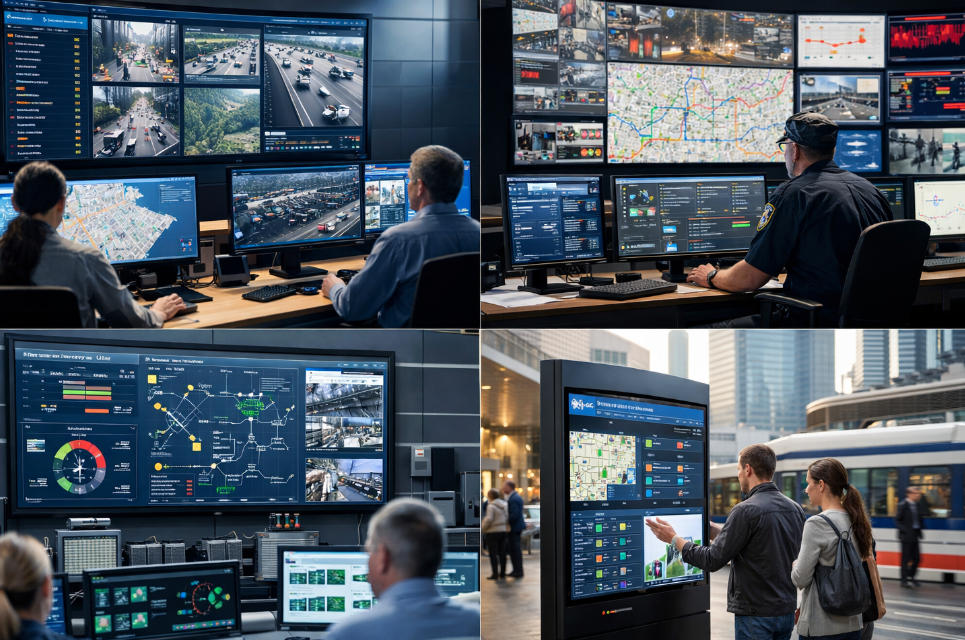
Smart cities rely heavily on intelligent energy and utility systems to improve efficiency and sustainability. Industrial displays are widely used in power substations, water treatment facilities, and renewable energy control centers.
These displays allow operators to:
Monitor energy consumption and grid performance
Detect faults and anomalies in real time
Optimize resource distribution and reduce downtime
Their resistance to electrical interference and ability to function in industrial environments make them ideal for utility management applications.
Smart cities aim to improve quality of life through better communication with citizens. Industrial displays are increasingly used in public spaces such as airports, hospitals, government buildings, and city squares.
Applications include:
Digital signage for public announcements
Wayfinding and navigation systems
Interactive kiosks for city services
Because industrial displays offer long-term stability and consistent performance, they reduce maintenance costs while ensuring accurate information delivery to the public.
A defining advantage of industrial displays is their extended product lifecycle. Many smart city projects are designed to operate for 10–15 years or longer. Industrial displays are manufactured with long-term component availability, reducing the risk of system redesigns or compatibility issues.
Their robustness minimizes downtime and maintenance, resulting in a lower total cost of ownership compared to consumer-grade alternatives. This reliability is critical for large-scale smart city deployments where system failures can disrupt essential services.
Smart cities thrive on data, and industrial displays transform complex data streams into actionable visual insights. By integrating with IoT platforms, AI analytics, and cloud-based systems, these displays help decision-makers interpret data quickly and accurately.
Whether in command centers or decentralized field installations, industrial displays ensure that data-driven decisions are supported by clear, real-time visualization.
Industrial displays are a foundational technology for smart cities. Their durability, reliability, and performance enable seamless operation across transportation, public safety, utilities, and citizen services. As cities continue to adopt intelligent infrastructure, industrial displays will remain critical in bridging the gap between advanced digital systems and human interaction. Investing in high-quality industrial display solutions is not only a technical necessity but a strategic decision for building sustainable, resilient, and efficient smart cities.











 IPv6
IPv6