



Sustainable & Energy-Efficient Industrial Displays: The Future of Responsible Industrial Visualization
Industrial displays play a critical role in today’s manufacturing, automation, logistics, transportation, smart infrastructure, and digital signage environments. As global industries accelerate sustainability goals and stricter energy regulations, energy-efficient display technology is no longer a bonus—it’s a competitive necessity. Sustainable and energy-efficient industrial displays combine rugged performance with lower energy consumption, reduced total cost of ownership (TCO), and alignment with corporate ESG (Environmental, Social, Governance) goals.
This article explores how industrial displays are evolving toward greater sustainability, what energy efficiency means in this sector, and how leading manufacturers like Oscy Monitor are aligning products with stringent standards and real-world industrial needs.
Industrial displays often run 24/7, operate in extreme environments, and can consume significant power over long lifecycles. Unlike consumer screens, industrial displays must withstand temperature extremes, dust, vibration, and continuous use—so durability and performance have historically been prioritized above energy efficiency. While ruggedness remains essential, modern energy-efficiency standards and sustainability targets now require manufacturers to rethink display design holistically.
Key sustainability drivers include:
Reduced Operational Costs: Lower energy usage directly translates to reduced electricity bills, especially in facilities with hundreds or thousands of displays running continuously.
Carbon Footprint Reduction: Cutting power consumption contributes to corporate sustainability objectives and compliance with carbon-emissions regulations.
Longer Lifecycle & Less Waste: Durable, energy-optimized displays reduce replacement cycles, minimizing electronic waste—one of the fastest-growing waste streams globally.
Regulatory Compliance: New standards such as China’s GB 21520-2023 set energy-efficiency limits and grades for displays, including industrial types that historically were unregulated, fostering broader market adoption of energy-efficient technologies.
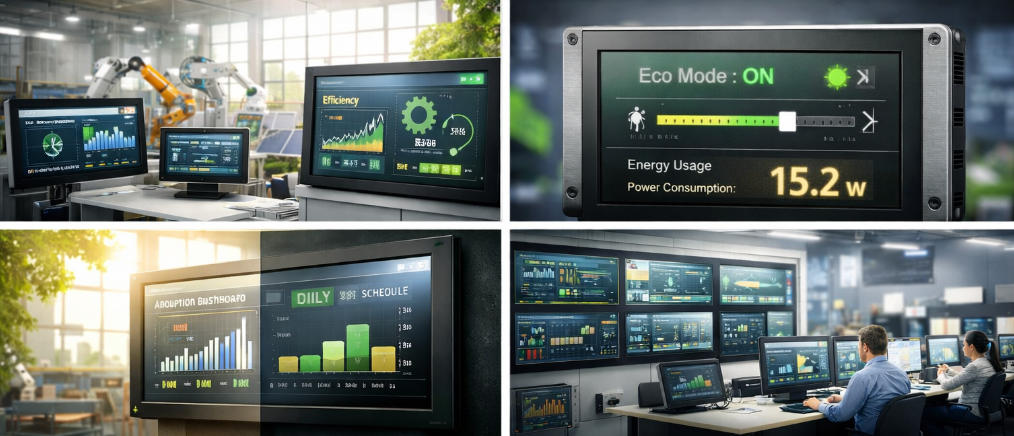
Industrial display energy consumption can be measured similarly to consumer and commercial monitors, though specialized standards increasingly include industrial categories:
ENERGY STAR Certification: In markets like the U.S., ENERGY STAR sets strict efficiency requirements for displays and signage, covering on-mode, sleep, and off-mode power limits. ENERGY STAR-certified monitors are typically more energy efficient than conventional models.
GB 21520-2023 (China): This new standard significantly expands energy-efficiency requirements to include LCD, OLED, and integrated LED displays. It defines three efficiency grades and mandates testing for on-mode, sleep, and off-mode power consumption—ensuring consistent energy performance reporting across product categories.
Industrial displays must balance demanding performance (brightness, resolution, reliability) with energy conservation. Key metrics include:
Power Consumption in On Mode: The energy draw when actively displaying content.
Low Power Mode / Sleep Mode: Standards increasingly mandate low energy use in idle states to minimize wasted energy.
Energy Efficiency Grades: Defined by standards (e.g., Level 1, Level 2, Level 3 in GB 21520-2023) that support buyers and regulators in comparing products.
To meet sustainability targets without compromising industrial performance, manufacturers apply several technical strategies:
LED backlight systems over traditional CCFL lamps improve brightness per watt and reduce energy usage.
Adaptive Brightness Control: Automatically adjusts display brightness based on ambient light to minimize unnecessary power usage during lower-light conditions.
Efficient Power Delivery: Displays designed with optimized power rails, low-loss power components, and low-power graphics controllers reduce electrical waste throughout operation.
Sleep and Standby Optimization: Ensuring minimal energy use when idle, without impairing responsiveness, is crucial for large industrial deployments.
Fanless Design: In some energy-efficient models, passive thermal management avoids active cooling components, reducing both energy use and potential points of failure.
Wide Voltage Input: Supporting broad DC power ranges (e.g., 9–36 V) reduces the need for additional power converters and supports energy optimization in mobile or renewable-powered industrial sites.
In smart factories, industrial displays often serve as HMIs (Human-Machine Interfaces), SCADA panels, or machine status dashboards. Energy efficient displays reduce cumulative energy consumption across large production floors while supporting mission-critical responsiveness and clarity.
Energy-optimized displays help enterprises achieve greener buildings, lower cooling loads, and reduced operating expenses—particularly when screens run continuously for signage, status boards, or wayfinding.
Persistent display deployment in airports, rail stations, and warehouses means energy consumption scales quickly. Efficient display technology can significantly reduce infrastructure load and improve sustainability ratings.
Oscy Monitor stands out as an industrial display OEM/ODM manufacturer with more than 14 years of experience crafting industrial displays designed for durability and integration. Their product portfolio is engineered to support a range of industrial uses from embedded control systems to digital signage and transportation dashboards.
While ruggedness and reliability remain core, Oscy’s industrial displays increasingly align with modern efficiency expectations by:
Incorporating LED backlight systems and energy-optimized components that support reduced power consumption.
Adhering to environmental standards such as RoHS that restrict hazardous substances and facilitate recyclability.
Utilizing adaptive brightness technologies and efficient driver designs to lower energy use without sacrificing visibility.
Providing customization options that allow battery- or solar-powered applications in off-grid or energy-restricted industrial sites.
By building rugged displays capable of 24/7 operation under harsh conditions, Oscy helps minimize premature replacements and supports sustainable lifecycle management—a crucial factor in industrial ESG strategies. oscymonitor.com
To maximize energy efficiency and sustainability in industrial display projects:
Evaluate Energy Efficiency Ratings: Look for displays meeting or exceeding relevant ENERGY STAR or national regulatory requirements.
Check Standby & Sleep Power Performance: Assess how displays handle idle states to avoid unnecessary energy draw. The Department of Energy's Energy.gov
Leverage Adaptive Brightness: Choose displays with intelligent brightness adjustment to reduce power use in variable light conditions.
Design for Lifecycle & Durability: Prioritize rugged displays with long operational lifespans to reduce waste and lower overall TCO.
Integrate Smart Power Management: Combine display features with automated system controls (e.g., scheduling, smart shutdown) for optimized energy usage.
Sustainable and energy-efficient industrial displays are essential for modern industrial environments that demand durability, performance, and environmental responsibility. By combining advanced power-saving technologies, compliance with evolving standards, and rugged industrial design, manufacturers like Oscy Monitor empower enterprises to reduce energy consumption, lower operational costs, and support broader sustainability goals. Whether for smart manufacturing, digital signage, transportation, or automation control, energy-efficient displays represent a strategic advantage in a world increasingly focused on resource optimization and environmental stewardship.











 IPv6
IPv6