



As industrial environments become increasingly data-driven, the demand for faster, more reliable decision-making at the edge has never been higher. Edge computing displays play a critical role in this transformation by enabling real-time visualization, processing, and interaction directly at the data source. For industrial buyers, understanding how these displays function—and how to select the right solution—is essential for optimizing operations, reducing latency, and improving system resilience.
This article explores the fundamentals of edge computing displays, their industrial applications, key selection criteria, and emerging trends that buyers should consider before investing.
Edge computing displays are industrial-grade visual interfaces integrated with local processing capabilities. Unlike traditional displays that rely on centralized cloud or server systems, edge computing displays process and present data locally, close to machines, sensors, or control systems.
By combining embedded computing power with rugged display hardware, these systems support real-time analytics, human-machine interfaces (HMI), and localized decision-making without dependence on constant network connectivity.
Industrial operations often operate in environments where latency, downtime, and data security are critical concerns. Edge computing displays address these challenges in several key ways:
Low Latency Performance
Local data processing enables instant visualization and response, which is crucial for automation, robotics, and safety systems.
Improved Reliability
Even during network interruptions, edge displays continue operating independently, ensuring uninterrupted production and monitoring.
Enhanced Data Security
Sensitive operational data can be processed on-site, reducing exposure to external networks and cloud vulnerabilities.
Operational Efficiency
Real-time insights at the machine level allow operators to identify issues faster and optimize workflows.
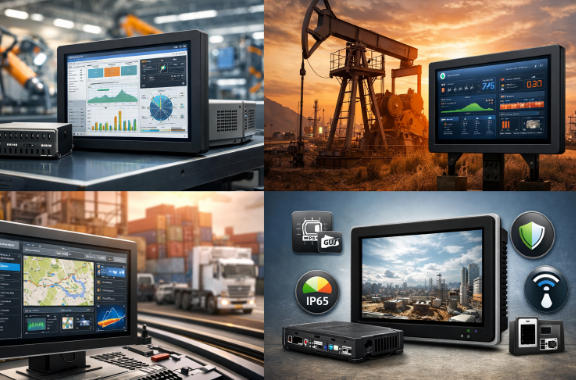
Edge computing displays are widely used across multiple industrial sectors, including:
Manufacturing and Factory Automation
Serving as HMIs for PLCs, robots, and production lines, enabling real-time monitoring and control.
Energy and Utilities
Supporting local data visualization in substations, renewable energy systems, and remote monitoring stations.
Transportation and Logistics
Providing on-site analytics for traffic systems, fleet management, and warehouse automation.
Oil, Gas, and Mining
Operating reliably in harsh, remote environments where connectivity is limited.
When selecting edge computing displays, buyers should focus on the following critical factors:
Evaluate CPU, GPU, and memory capabilities to ensure the display can handle required analytics, visualization, and AI workloads.
Industrial deployments require displays with features such as:
Wide temperature tolerance
High brightness and sunlight readability
IP-rated protection against dust, water, and vibration
Look for flexible interfaces, including Ethernet, USB, serial ports, CAN bus, and wireless connectivity, to integrate seamlessly with existing systems.
Ensure support for industrial operating systems and protocols, such as Linux, Windows IoT, OPC UA, and MQTT.
Long product lifecycles, backward compatibility, and vendor support are critical for industrial environments with extended deployment timelines.
Traditional industrial displays primarily function as passive visualization devices connected to centralized systems. In contrast, edge computing displays integrate processing, analytics, and visualization into a single platform.
This convergence reduces system complexity, lowers infrastructure costs, and enables distributed intelligence—making edge computing displays a more future-proof solution for smart industrial systems.
Several trends are shaping the evolution of edge computing displays:
AI at the Edge: Integration of machine learning for predictive maintenance and quality inspection
Higher Resolution and Touch Technologies: Improved usability for complex data visualization
5G and TSN Integration: Faster, more deterministic industrial communication
Modular and Customizable Designs: Tailored solutions for specific industrial use cases
As Industry 4.0 adoption accelerates, edge computing displays will become a standard component of intelligent industrial infrastructure.
For industrial buyers, edge computing displays represent more than just a visual interface—they are a strategic investment in operational intelligence, resilience, and efficiency. By carefully evaluating performance, durability, connectivity, and long-term support, organizations can select solutions that align with their digital transformation goals.
Understanding the role and value of edge computing displays is a critical step toward building smarter, more responsive industrial systems.











 IPv6
IPv6