




Industrial Human-Machine Interface (HMI) displays are undergoing a significant transformation as manufacturing, energy, transportation, and process industries accelerate their digitalization efforts. Between 2025 and 2026, HMI display design is no longer just about visualization—it is becoming a strategic tool for productivity, safety, and intelligent decision-making.
Driven by Industry 4.0, IIoT, AI integration, and user-centered design principles, modern industrial HMI displays are evolving to be smarter, more intuitive, and more resilient. This article explores the key trends in industrial HMI display design for 2025–2026, highlighting how technology, usability, and industrial requirements are converging.
One of the most prominent trends in industrial HMI display design is the shift toward user-centered, minimalist interfaces. Complex data-rich screens are being replaced with cleaner layouts that emphasize clarity and actionable information.
Simplified color palettes with high contrast
Clear typography optimized for industrial environments
Context-based information display
Reduced visual clutter to minimize operator fatigue
For 2025–2026, HMI designers are increasingly applying UX/UI principles borrowed from consumer technology, improving learnability and reducing training time for operators.
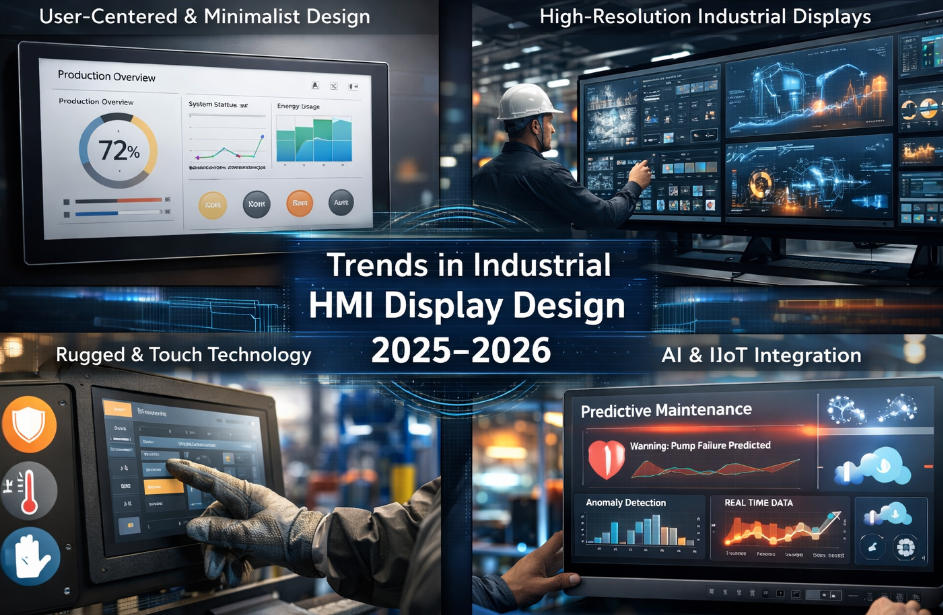
Industrial HMI displays are becoming larger and sharper. High-resolution panels such as Full HD and 4K are increasingly adopted, especially in control rooms and advanced manufacturing facilities.
Improved readability of complex data
Enhanced visualization of dashboards and analytics
Better support for multi-window and split-screen layouts
Additionally, edge-to-edge glass designs and narrower bezels contribute to a modern, professional appearance while maximizing screen real estate.
Touch interaction continues to dominate industrial HMI display design, but 2025–2026 will see broader adoption of advanced touch technologies, including:
Projected capacitive (PCAP) touch with glove support
Multi-touch gestures for zooming, panning, and object manipulation
Improved responsiveness under harsh conditions
In some high-end applications, gesture recognition and proximity sensing are emerging as complementary input methods, reducing physical contact and improving hygiene and safety.
Industrial environments demand durability. Future HMI display designs focus on enhanced ruggedization without compromising aesthetics or usability.
Key design considerations include:
Wider operating temperature ranges
Higher IP ratings for dust and water resistance
Anti-glare, anti-reflective, and optically bonded screens
Improved vibration and shock resistance
These features ensure reliable performance in factories, outdoor installations, marine systems, and energy infrastructure.
As Industrial Internet of Things (IIoT) ecosystems expand, HMI displays are becoming central visualization hubs. HMI design trends emphasize seamless integration with sensors, PLCs, cloud platforms, and edge computing devices.
Modern HMI displays now support:
Real-time data visualization
Remote monitoring and control
Secure connectivity via Ethernet, wireless, and industrial protocols
This connectivity allows operators and engineers to make faster, data-driven decisions across distributed industrial systems.
A major innovation for 2025–2026 is the integration of AI-powered analytics into industrial HMI displays. Instead of passively showing data, HMIs are beginning to interpret and prioritize information.
Examples include:
Predictive maintenance alerts
Anomaly detection and early fault warnings
Adaptive dashboards based on user roles
This shift transforms industrial HMI displays into intelligent assistants that enhance operational efficiency and reduce downtime.
With increasing connectivity comes higher cybersecurity risk. HMI display design trends now incorporate security-by-design principles.
Important elements include:
Role-based access visualization
Secure boot and encrypted communication indicators
Visual alerts for abnormal system behavior
By integrating security awareness directly into the HMI interface, organizations can better protect critical industrial assets.
Flexibility is becoming essential. Manufacturers are moving toward modular HMI display designs that can be easily customized for different applications, industries, or user roles.
Advantages include:
Faster deployment
Lower lifecycle costs
Easier upgrades and scalability
Customizable layouts and software-defined interfaces ensure that industrial HMI displays remain future-proof.
The industrial HMI display design trends for 2025–2026 reflect a clear shift toward intelligence, usability, and resilience. As industrial systems grow more complex, HMI displays are evolving from simple control panels into sophisticated, user-focused platforms that support real-time decision-making and digital transformation.
Organizations that invest in modern HMI display design will benefit from improved efficiency, enhanced safety, and greater adaptability in an increasingly connected industrial landscape.



 IPv6
IPv6