



Industrial displays are widely used in manufacturing automation, transportation systems, medical equipment, energy infrastructure, and outdoor environments. Unlike consumer displays, industrial displays must meet stringent regulatory, safety, and environmental requirements due to their long lifecycle, harsh operating conditions, and mission-critical roles.
To ensure compliance and market access, industrial displays must obtain recognized certifications such as CE, RoHS, IEC 62368, and CCC. Understanding these certifications is essential for manufacturers, OEMs, and buyers seeking reliable, legally compliant, and globally marketable display solutions.
This article provides a detailed overview of the most important industrial display certifications, explaining their purpose, scope, and impact on product design and international trade.
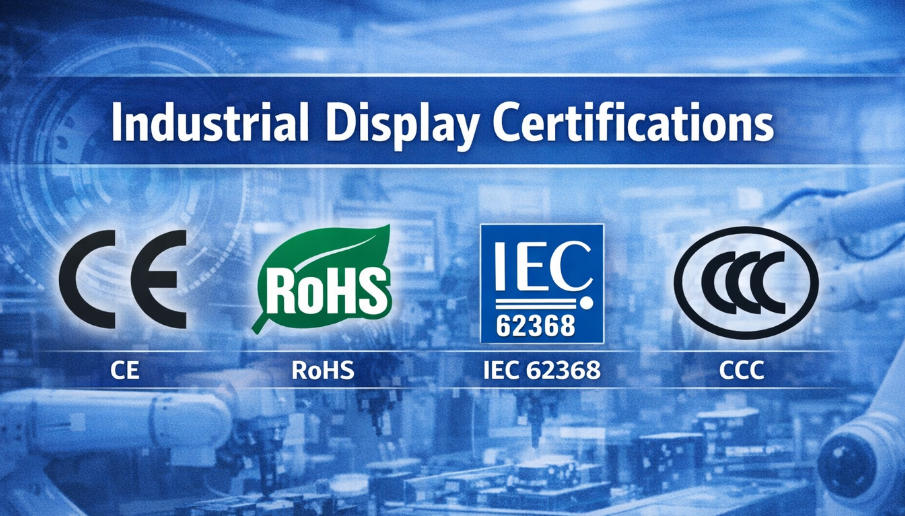
Industrial display certifications serve three critical purposes:
Regulatory Compliance – Certifications ensure products meet national and international laws.
Product Safety and Reliability – Certified displays reduce risks related to electrical hazards, fire, and environmental impact.
Market Access and Trust – Certifications enable entry into regulated markets and increase buyer confidence.
Failure to comply with required certifications can result in shipment delays, fines, product recalls, or denial of market access.
CE marking is a mandatory conformity mark for products sold within the European Economic Area (EEA). It indicates that a product complies with applicable EU directives related to safety, health, and environmental protection.
Industrial displays typically fall under several EU directives, including:
Low Voltage Directive (LVD) 2014/35/EU
Electromagnetic Compatibility (EMC) Directive 2014/30/EU
RoHS Directive 2011/65/EU
Ecodesign and Energy-related regulations (when applicable)
To obtain CE certification, manufacturers must:
Identify applicable EU directives
Conduct conformity assessments and testing
Prepare technical documentation (Technical File)
Issue an EU Declaration of Conformity
Affix the CE mark to the product
CE certification is essential for selling industrial displays in Europe. It demonstrates compliance with safety and EMC requirements, ensuring displays operate reliably in industrial environments without interfering with other equipment.
RoHS (Restriction of Hazardous Substances) restricts the use of specific hazardous materials in electrical and electronic equipment. The directive aims to reduce environmental impact and improve recyclability.
RoHS limits substances such as:
Lead (Pb)
Mercury (Hg)
Cadmium (Cd)
Hexavalent Chromium (Cr⁶⁺)
Polybrominated Biphenyls (PBB)
Polybrominated Diphenyl Ethers (PBDE)
Certain phthalates (DEHP, BBP, DBP, DIBP)
Industrial displays contain electronic components, PCBs, cables, and backlighting systems that must comply with RoHS substance limits. Manufacturers must ensure:
RoHS-compliant components and materials
Supplier material declarations
Ongoing compliance through production control
Mandatory for EU market access
Supports global environmental regulations
Enhances corporate sustainability and brand image
IEC 62368-1 is an international safety standard for audio/video, information, and communication technology equipment. It replaces older standards such as IEC 60950 and IEC 60065.
Industrial displays increasingly fall under IEC 62368 due to their integration into IT and control systems.
Unlike traditional standards, IEC 62368 uses a hazard-based approach, focusing on:
Electrical energy hazards
Thermal hazards
Mechanical and fire hazards
Radiation and chemical hazards
IEC 62368 applies to:
Industrial LCD and LED displays
Touchscreen monitors
Embedded panel PCs with display functions
Displays powered by AC or DC sources
Required for many international markets
Enhances safety design during early development
Simplifies compliance across multiple regions
For manufacturers targeting Europe, North America, and Asia, IEC 62368 compliance significantly reduces certification complexity.
CCC (China Compulsory Certification) is a mandatory product certification system for products sold in mainland China. It is administered by the State Administration for Market Regulation (SAMR).
CCC requirements depend on:
Display type and voltage rating
Power supply configuration
End-use application
Some industrial displays, especially those with integrated power supplies or higher voltage ratings, may require CCC certification.
The CCC process typically includes:
Product testing at accredited Chinese laboratories
Factory inspection and audit
Ongoing follow-up inspections
Certification issuance and marking
Mandatory for legal sale in China
Required for customs clearance
Demonstrates compliance with Chinese safety standards
Manufacturers exporting industrial displays to China must carefully verify CCC applicability early in the product planning stage.
| Certification | Region | Focus Area |
|---|---|---|
| CE | European Union | Safety, EMC, environmental compliance |
| RoHS | EU & global | Hazardous substance restriction |
| IEC 62368 | Global | Product safety |
| CCC | China | Safety and regulatory compliance |
For global industrial display suppliers, achieving multi-certification compliance ensures smooth international distribution and reduces redesign costs.
Design with certification requirements in mind from the earliest development stage
Use certified components and power supplies
Maintain complete technical documentation
Work with accredited testing laboratories
Monitor regulatory updates and standard revisions
Proactive compliance management helps avoid delays and ensures long-term product viability.
Understanding industrial display certifications such as CE, RoHS, IEC 62368, and CCC is essential for manufacturers and buyers operating in global markets. These certifications ensure product safety, environmental responsibility, and legal compliance while enhancing customer trust and brand credibility.
As industrial display applications continue to expand across automation, transportation, and smart infrastructure, certification compliance will remain a critical factor in successful product deployment.











 IPv6
IPv6